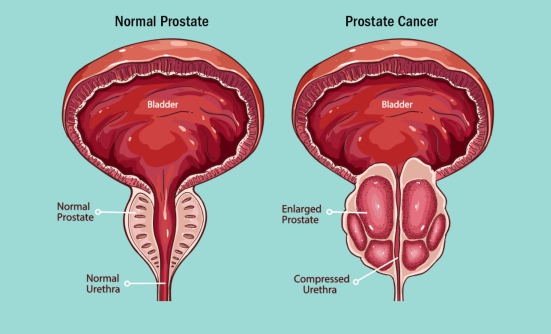




If you are facing prostate cancer, it’s important to understand the staging of the cancer and how this information impacts your treatment options. Your healthcare team should take the time to explain the staging and answer all your questions. When that happens, you just might have an “exhale moment,” when you regain a feeling of control, maybe even relief, as your healthcare provider helps to guide you through the treatment decision-making process.
Prostate Cancer Staging Defined
Staging is a description of the cancer that answers the following questions: (1) where is it located? (2) has it spread and if so, where? (3) is it affecting other parts of the body?
In newly diagnosed localized prostate cancer, clinical staging includes the results of a digital rectal exam, PSA blood levels, and Gleason score.
Prostate cancer has 2 types of staging, pathologic and clinical. Pathologic staging is done after surgery is complete and involves looking at the entire prostate and some lymph nodes. In newly diagnosed localized prostate cancer, clinical staging includes the results of a digital rectal exam, prostate-specific antigen blood levels, and Gleason score.1 Staging will help guide you and your healthcare team to make treatment decisions.
Gleason Score
The Gleason score is a grading system used to evaluate the aggressiveness of prostate cancer. It’s named after Dr. Donald Gleason, who developed the system in the 1960s. The score is based on the appearance of the prostate cancer cells when examined under a microscope after a biopsy.2 Here’s how it works:
- Biopsy: During a prostate biopsy, a small sample of tissue is taken from the prostate gland. This tissue is then examined by a pathologist under a microscope
- Grading: The pathologist assigns a grade to the cancer cells based on their appearance. The Gleason grading system ranges from 1 to 5 and describes how much the cells look like healthy tissue (lower score) or abnormal tissue (higher score), with 1 being the least aggressive and 5 being the most aggressive (Figure)3
- Summing: The pathologist assigns grades to the most common and the second most common cancer cell patterns observed in the biopsy. These 2 grades are then added together to get the Gleason score. For example, if the most common pattern is grade 3 and the second most common pattern is grade 4, the Gleason score would be 7 (3+4)
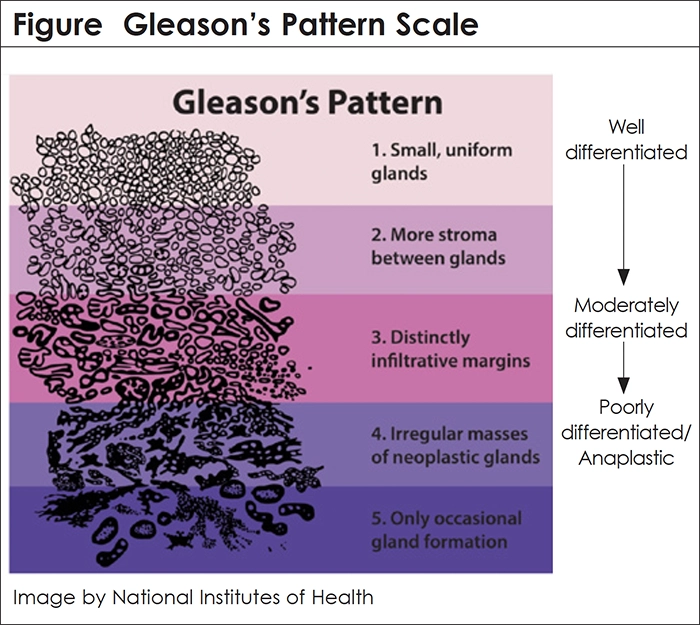
Understanding the Gleason score can be complex when you’re not familiar with medical terminology or cancer grading systems. In general, a higher Gleason score indicates a more aggressive form of prostate cancer, while a lower score suggests a less aggressive cancer. Most cancers are grade 3 or higher.
Gleason Grade Group
Grade Groups are a relatively new way to further classify prostate cancer risk. This new prostate cancer grading system was developed during the 2014 International Society of Urological Pathology (ISUP) Consensus Conference. Grade Groups range from 1 (most likely to grow and spread slowly) to 5 (most likely to grow and spread quickly):
- Grade Group 1 = Gleason 6 (or less)
- Grade Group 2 = Gleason 3+4=7
- Grade Group 3 = Gleason 4+3=7
- Grade Group 4 = Gleason 8
- Grade Group 5 = Gleason 9-10
Although eventually the Grade Group system may replace the Gleason system, the 2 systems are currently reported side-by-side.4
AJCC/TNM Staging System
Another tool used to describe the stage is the American Joint Committee on Cancer (AJCC) staging system. The AJCC system uses the internationally accepted tumor-node-metastasis (TNM) classification. Diagnostic tests and scans are used to answer these questions:
- Tumor (T): How large is the primary tumor? Where is it located?
- Node (N): Has the tumor spread to the lymph nodes? If so, where and how many? [Lymph nodes are small, bean-shaped organs that help fight infection]
- Metastasis (M): Has the cancer spread to other parts of the body? If so, where and how much?
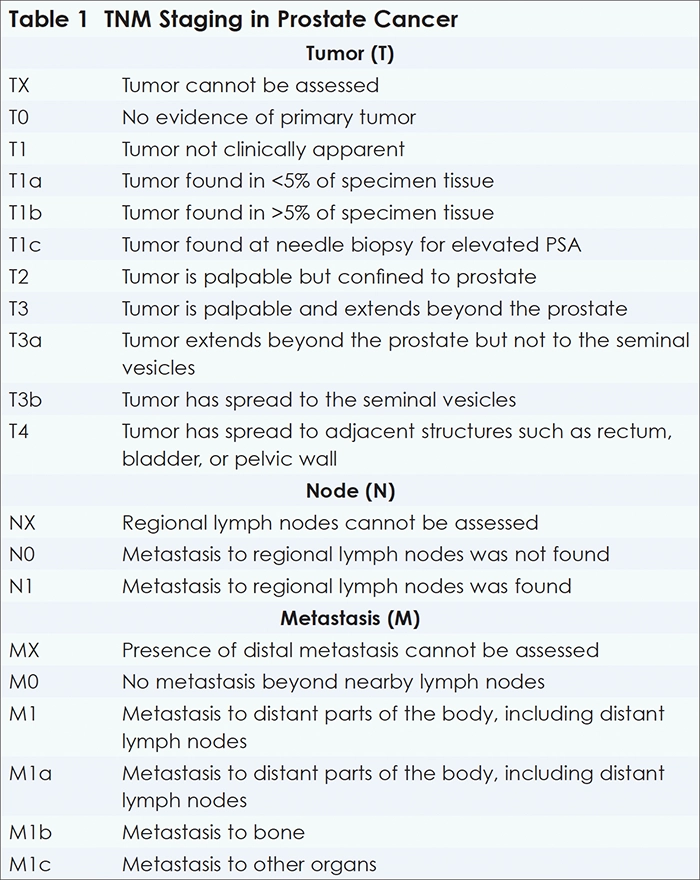
When the TNM system is used, numbers follow each letter to give more information (Table 1).5
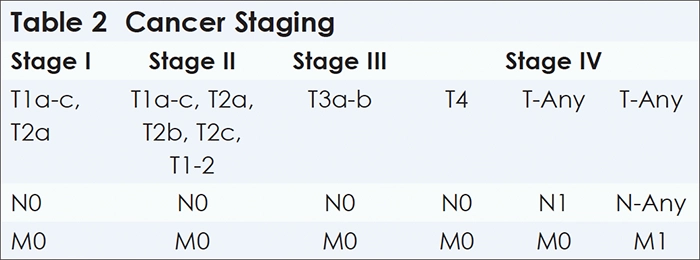
Using the TNM system, the results are combined to determine the stage of cancer for each person. There are 5 AJCC stages: stage 0 (zero) and stages I through IV (1 through 4). The stage provides a common way of describing the cancer, so doctors can work together to plan the best treatments. Table 2 outlines prostate cancer staging.1,6
Translating Staging Into Treatment Options: NCCN Guidelines
The National Comprehensive Cancer Network (NCCN) provides evidence-based guidelines for the management of various cancers, including prostate cancer. These guidelines are regularly updated by a panel of experts and incorporate the latest research findings and clinical evidence. The specific treatment recommendations outlined in the NCCN guidelines for prostate cancer may vary based on factors such as the stage of the disease, Gleason score, PSA level, age, and overall health.7
The information in the staging summary provides enough information to categorize risk and identify recommended treatment options. You may still have a choice to make among viable options for most risk categories. Treatment decision-making at this point goes beyond just the efficacy of the treatment and should include a comparison of possible side effects and quality-of-life issues.
The staging of prostate cancer impacts your treatment options. For example, there are several treatment options for a Grade Group 3 cancer, but active surveillance is not recommended. However, for a Grade Group 2 cancer (assuming PSA under 10, less than 50% of biopsy cores with cancer, among other factors), active surveillance can be an option, as well as surgery alone or radiation without hormones, if in the NCCN Favorable Intermediate Risk Category.
Your nurse navigator and/or healthcare team can provide valuable support to you, helping you to understand the staging system used and to consider all the possibilities when comparing the available treatment options. With experience, nurse navigators can present anecdotal scenarios of how other men made their treatment decisions with a similar clinical situation, to give you another perspective to consider.
A Final Thought
Understanding the details and nuances of cancer staging for prostate cancer can help make the treatment decision process smoother. Your nurse navigator is in a key position to help with this essential exercise of due diligence while providing a neutral, yet supportive, position to assist you in exploring all your treatment options.
The first step is setting the stage.
About the Author
Frank dela Rama, RN, MS, AOCNS, AGN-BC is a Clinical Nurse Specialist in Oncology/Genomics at Sutter Palo Alto Foundation in Palo Alto, California.
References
- American Society of Clinical Oncology. Prostate cancer: stages and grades. December 2022. Accessed May 6, 2024. www.cancer.net/cancer-types/prostate-cancer/stages-and-grades
- Delahunt B, Miller RJ, Srigley JR, et al. Gleason grading: past, present and future. Histopathology. 2012;60:75-86.
- National Institutes of Health. Gleason’s pattern. Accessed May 7, 2024. https://training.seer.cancer.gov/prostate/abstract-code-stage/morphology.html
- American Cancer Society. Your prostate pathology report: cancer (adenocarcinoma). Updated July 7, 2023. www.cancer.org/cancer/diagnosis-staging/tests/biopsy-and-cytology-tests/understanding-your-pathology-report/prostate-pathology/prostate-cancer-pathology.html
- Johns Hopkins Medicine. Health. Prostate cancer stages. Accessed May 20, 2024. www.hopkinsmedicine.org/health/conditions-and-diseases/prostate-cancer/prostate-cancer-stages
- The “New” Prostate Cancer InfoLink. Clinical staging. Accessed May 14, 2024. https://prostatecancerinfolink.net/treatment/staging-grad ing/clinical-staging/
- National Comprehensive Cancer Network. NCCN Clinical Practice Guidelines in Oncology (NCCN Guidelines) Prostate Cancer. Version 1.2024. Accessed February 27, 2024. www.nccn.org/guidelines/nccn-guidelines/guidelines-detail?category=1&id=1459