



If you are a woman at average risk for breast cancer, you have probably heard that you should start getting your annual screening mammogram around age 40. And if you decide to search online for more information, as many of us do, you might find yourself more confused than when you first started.
Today, there’s not just 1, but at least 6 different recommended guidelines for screening mammograms (Table). One organization says you should begin your screenings promptly at age 40, while another says you can wait until you turn 50. One recommends you receive your screening once a year, while another says it doesn’t need to happen more than once every 2 years. On top of it all, opinions also differ about when to stop screening. Why are there so many different and conflicting recommendations coming from these trusted medical organizations?
If you are feeling frustrated or confused, you’re not alone. Some experts worry that this confusion could cause patients to delay or skip their screenings altogether. This could lead to much later detection, when breast cancer is at a more advanced stage and harder to treat. The good news is that these conflicting guidelines don’t mean that some organizations care less about timely mammograms than others do. Instead, these differing views are really a snapshot of our ever-evolving understanding of breast cancer. They reflect a growing awareness that one standard screening recommendation may not be right for everyone.
Why Do These Organizations Have Different Recommendations?
Shifting mammogram guidelines are an ongoing topic in the news media. If you follow the latest medical news, you may have seen recent changes to the breast cancer screening guidelines from the American College of Physicians (ACP). In the latest update, the ACP states that women aged 50 to 74 years should receive breast cancer screenings every 2 years, while women between the ages of 40 and 49 should discuss the pros and cons of screening with their doctors. They also recommend that women of average risk should discuss stopping their screening at age 75.¹
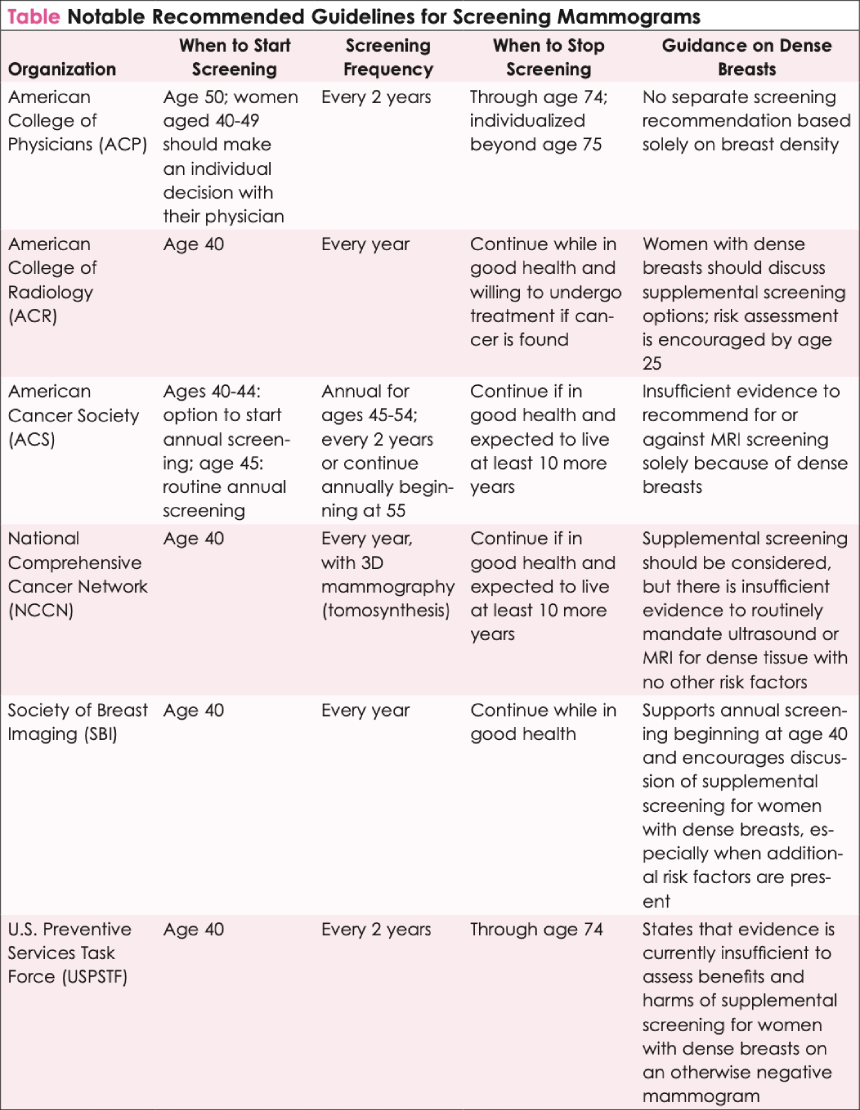
In response to this recent announcement, the American College of Radiology and the Society of Breast Imaging issued a joint statement refuting these guidelines and urging women to begin their screenings at age 40.² The United States Preventive Services Task Force and National Comprehensive Cancer Network also recommend women start screening by age 40, pointing to recent data that show the greatest reduction in mortality is achieved by screening women starting at this age.³
“We’re currently seeing an undeniable shift that there is a small but statistically relevant increase of breast cancer in young women,” says Kelsey Hampton, PhD, director of mission communications at Susan G. Komen. “The benefits to diagnosing someone earlier are that there are more tools available and the outcomes are generally better.”
However, the ACP defends their new guidelines by arguing that the potentially negative impact of early screening, including false-positive results (test results that indicate you have a disease when you do not); overdiagnosis (finding an existing condition that would not have caused problems); overtreatment (unnecessary treatment for a disease that would not have caused problems), as well as additional testing, radiation exposure, and psychological distress, may far outweigh the benefits. In response, critics of the ACP argue that these screening risks are overstated and not well founded.⁴
This conflict illustrates how competing priorities between organizations often lead to different guidelines. These groups may also interpret the same population data in different ways, having different views of what people at “average risk” need. This doesn’t necessarily mean that one organization is right while the others are wrong. These are just examples of how different organizations interpret the same complex evidence.
“One reason these recommendations differ is because they are built on population-level data,” Dr. Hampton explains. “But recommendations for an entire community do not consider an individual’s personal risk factors, such as their unique health history, family history, or anything else that might be a factor. We would really like these recommendations to be a starting point for a conversation about what makes the most sense for each person, because what works for a population does not always apply to you as an individual.”
From One-Size-Fits-All to a Personalized Screening Strategy
As Dr. Hampton indicated, personalized screening has become increasingly important, and doctors are shifting away from a “one-size-fits-all” approach and considering the unique biology and risk factors of each individual. While age is a known risk factor, breast cancer screening should not be based on age alone. A more complete picture of a person’s risk can come from combining age with other factors like breast density, family history, race and/or ethnicity, genetic testing, and lifestyle factors. With a more detailed assessment, your doctor can help you determine the best time to start screening, whether to screen annually or every 2 years, when to stop screening, and whether additional imaging is needed.
“Someone’s general risk can be determined by lots of different factors, including family health history,” Dr. Hampton says. “It’s important to have those conversations with your doctor and be thinking about the bigger picture and how it applies to you.”
Having dense breasts is another important factor in planning your screenings. On a mammogram, dense breast tissue appears white, which can mask tumors because they look white too. The FDA now requires clinics to send a follow-up letter that tells you whether or not you have dense breast tissue.⁵ However, these letters can be confusing, and many women aren’t sure what to do next.
“This letter is a starting point,” Dr. Hampton says. “It is a data point of information, so you should talk with your doctor because having high breast density can be a factor that puts you at higher risk.”
The WISDOM Study: Evidence That Personalized Screening Can Lead to Better Outcomes
Although experts agree that breast cancer screening should not be one-size-fits-all, more clinical trials are needed to establish a new standard of care. Recent results of the Women Informed to Screen Depending on Measures of Risk (WISDOM) clinical trial presented at the 2025 San Antonio Breast Cancer Symposium by Laura Esserman, MD, revealed that a more personalized, risk-based approach to screening could lead to better outcomes for women aged 40 to 74 than the standard of annual mammography.⁶
The WISDOM trial is using a personalized approach that includes a woman’s unique risk factors, like age, lifestyle, family health history, results of genetic testing, and breast density. Participants are allowed to choose 1 of 2 study groups: the annual screening group that receives a mammogram once a year, or the personalized screening group that receives a custom-tailored screening plan with recommendations on when and how often to be screened for breast cancer, based on their individual risk.
Researchers are tracking both study groups to see how well each approach works, and so far, the results are promising. Dr. Esserman shared results of the first phase of the WISDOM trial at the 2025 San Antonio Breast Cancer Symposium.⁷ In its early phase, the study found that risk-based screening was not inferior to the established standard of annual screening. And with women at higher risk in the study receiving more attention and more intensive screening, the WISDOM trial also illustrates a shift toward a more patient-centered approach to screening.
More data are needed to fully understand the long-term impact of this personalized screening approach for women at average risk of breast cancer. Researchers hope the next phase of the WISDOM trial will prove that risk-based screening can be safe, acceptable, and potentially more beneficial for women than standard age-based screening.
Educational Resources From Komen
Featured topics and tools include:- Mammograms and breast cancer screening
- Clinical trials
- Breast Cancer 101 video series
- Breast cancer risk factors and screening
- My Family Health History tool
- Questions to Ask Your Doctor worksheet
Creating Your Personal Screening Plan
With so many different breast cancer screening guidelines out there, it is completely normal to feel overwhelmed. But there is one thing most experts agree on: the best approach is to sit down with your healthcare provider and create a screening plan based on your unique profile.
Start by having a conversation about risk factors like your age, family history, genetic mutations, dense breast tissue, and previous breast biopsies, or radiation to the chest area at a young age. Ask questions about your personal risk factors, the pros and cons of screening, and how different recommendations apply to your individual situation.
“I would urge people to make sure that the conversation is just that with their doctor: a conversation,” Dr. Hampton says. “Approach things with a place of curiosity and with the mindset that you and your doctor both want what’s best for you.”
Another important factor to discuss with your provider is the cost of screening, as insurance coverage for these tests can vary significantly based on your plan, your age, or your specific risk factors. For those who do not have insurance, healthcare providers are often familiar with local resources and financial assistance programs that can help cover the costs of screening.
Using broader population guidelines as a starting point, your provider can develop a custom screening plan that is shaped by the decisions you make together. The right plan should be a balance between evidence-based risks and your personal values, as you weigh the prospect of potential overdiagnosis versus the peace of mind and proven benefits that come with early detection.
“It’s important to have those conversations and be thinking about the bigger picture and how it applies to you,” Dr. Hampton says. “Because, unfortunately, in our health system, you have to be your own biggest advocate. You can have the best doctor in the world, but you also have to be willing to prioritize yourself and your care to make sure that you are getting what you need.”
If you feel like your current doctor isn’t meeting your needs, Dr. Hampton suggests getting a second opinion. Look for a provider who makes you feel supported and truly treats you as a partner in your own care.
“Remember that your doctor wants what’s best for you, and you can always ask questions,” Dr. Hampton says. “You can make decisions together as a team. It is not a one-way street.”
For more information on breast health or breast cancer, please call the Komen Patient Care Center’s Breast Care Helpline at 1-877 GO KOMEN (1-877-465-6636) or visit komen.org.
Susan G. Komen does not provide medical advice.
References
- American College of Physicians. New guidance from ACP says all average-risk females aged 50-74 should undergo biennial mammography screening for breast cancer. ACP Newsroom. April 17, 2026. Accessed June 15, 2026. www.acponline.org/acp-newsroom/new-guidance-from-acp-says-all-average-risk-females-aged-50-74-should-undergo-biennial-mammography
- ASCO Post. ACP issues controversial new breast cancer screening guidelines. June 25, 2026. Accessed June 25, 2026. https://ascopost.com/news/april-2026/acp-issues-controversial-new-breast-cancer-screening-guidelines/
- Katsika L, Boureka E, Kalogiannidis I, et al. Screening for breast cancer: a comparative review of guidelines. Life. 2024;14:777.
- Kopans DB. Arguments against mammography screening continue to be based on faulty science. Oncologist. 2014;19:107-112.
- FDA. Important information: final rule to amend the mammography quality standards act (MQSA). September 10, 2024. Accessed June 15, 2026. www.fda.gov/radiation-emitting-products/mammography-quality-standards-act-and-program/mqsa-program/important-information-final-rule-amend-mammography-quality-standards-act-mqsa
- Flores J. Shining a spotlight on risk-based approaches to breast cancer screening. Susan G. Komen blog. April 30, 2026. Accessed June 18, 2026. www.komen.org/blog/soct-wisdom-clinical-trial/
- Esserman LJ, Fiscalini AS, Naeim A, et al. Risk-based vs annual breast cancer screening. JAMA. 2025;335:763-774.
About the Authors
Jennifer Flores, MS, is a technical writer for Mission Communications and Educa- tion at Susan G. Komen. She is responsible for creating a variety of communica- tions materials including research blogs, impact reports, and web content. She is passionate about translating scientific information into more understandable con- tent for broad audiences and creating meaningful messages through storytelling.
Kelsey Hampton, PhD, is Director of Mission Communications and Education at Susan G. Komen, where she oversees a variety of patient education programs de- signed to translate scientific research and clinical trials to accessible, engaging, and actionable health information for patients. Dr. Hampton received her PhD in molecular and integrative physiology with an emphasis in cancer biology from the University of Kansas Medical Center.