
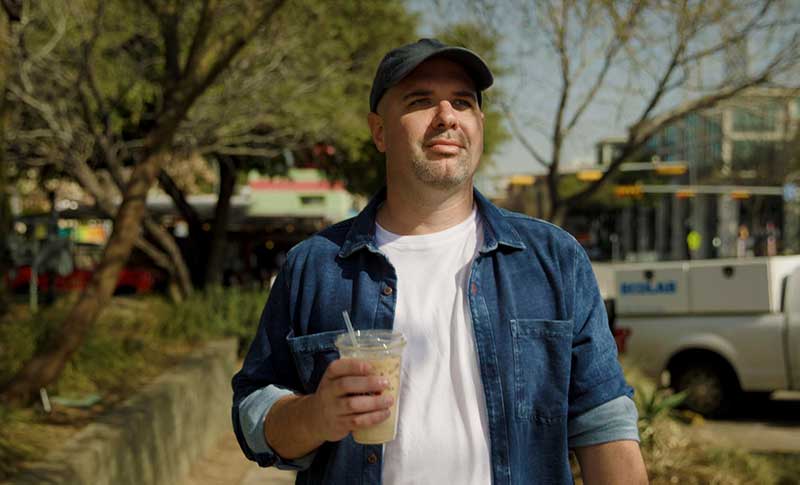
At 39, James “Jimi” Stewart was active, enjoying the outdoors and thinking about what the next chapter of his life might hold. Cancer wasn’t on his radar. Then he noticed blood in his urine.
CONQUER: the journey informed spoke with Jimi, now aged 40, about the bladder cancer diagnosis that followed, the decisions he faced during treatment, and the importance of communicating openly with his care team.
In this Q&A, he shares his experience and what he hopes others, particularly younger adults, can learn from his story.
CONQUER: Before your diagnosis, what did your life look like, and how did you first realize something might be wrong?
Jimi: Life was really good. I was 39, living in the Austin area around Round Rock. I had spent some time growing up in Southern California before that, so I loved the water and staying active and outdoors. Any day, you’d typically find me paddleboarding, tubing, or rollerblading with friends. I was also building my future, thinking about my next chapter, including hopes of finding that one person to share life with.Honestly, health wasn’t something I gave much thought to. I had been a smoker, and I just wasn’t focused on wellness concerns. Then one day, I noticed something that seemed minor at first—blood in my urine. It was alarming, but I didn’t immediately understand how significant it was. Still, something told me not to ignore it, and I got it checked out. That’s when everything changed very quickly. That one symptom led to a diagnosis I never saw coming.
CONQUER: What was going through your mind when you received the news of your diagnosis?
Jimi: Hearing bladder cancer was numbing. Something washes over you where you can’t process what is being told. I was only 39, and bladder cancer is typically more common in people 55 and older,1 so there was this extra shock to it. I was supposed to be in the prime of building my life, thinking about relationships and adventures, not fighting a life-threatening disease.Once the numbness passed, it became very real, very fast. What saved me in those first moments was my family and close friends who rallied around me immediately. We sat down together and walked through treatment options. There was fear, yes, but I knew I had to fight and couldn’t do it alone. My support system made all the difference right from the start.
CONQUER: When initial treatment didn’t work and bladder removal became a possibility, how did you process that turning point?
Jimi: After Bacillus Calmette-Guérin (BCG), which is the standard first-line treatment for bladder cancer, didn’t work for me, I was left facing a conversation about bladder removal. That terrified me. I kept thinking about how much that would change my life, my future, my ability to stay active, and the way I love. For someone my age, that felt like losing a major part of who I am.But I didn’t accept this was my fate. My urologist, care team, and I had an open conversation, and that’s when they introduced me to something I hadn’t heard of before, Inlexzo (gemcitabine intravesical system; Janssen Biotech, Inc). Learning that there was another option before making such a life-altering decision changed everything for me. It gave me hope when I needed it.
CONQUER: How did you learn about the FDA-approved treatment you received, and what made you decide to move forward with it?
Jimi: My care team discussed Inlexzo with me after BCG was unsuccessful. It’s a small, pretzel-shaped, intravesical drug-releasing system that your doctor places directly into your bladder. Unlike BCG, where you receive the treatment and then wait to urinate it out, this system stays in place and releases medicine slowly over time.What really sold me is that once it’s placed, I don’t even feel it. It works with my lifestyle—I can still be active; still do the things I love. And being the first patient in Texas to receive it meant I was part of something bigger. I was helping pave the way for others who might face the same crossroads I did. It felt right. I wasn’t just choosing treatment. I was choosing hope and a chance to keep living the life I wanted.
CONQUER: What role did communication with your care team play in your journey, and how did you advocate for yourself?
Jimi: This might be one of the most important parts of my entire journey. I have a wonderful physician assistant who genuinely listens to me, not just hears me, but truly listens. We have an open, honest relationship where we share every clinical decision together.When I’m experiencing symptoms or have concerns, I speak up, and she responds by working with me to find solutions.
The hardest part of this journey is UTIs [urinary tract infections]. When I don’t have them, I feel great, but when I have them, I feel terrible.
Open communication with my care team is why I’ve been able to stay on treatment and manage my bladder cancer symptoms. They really take the time to solve problems together. That’s the kind of support I wish every patient to have. Whatever you’re facing, ask your care team. There are often solutions.
CONQUER: Looking at where you are today, what do you most want others (especially younger adults) to understand about recognizing symptoms and navigating care?
Jimi: Right now, I’m in an incredible place. At my last 4 appointments, I’ve been cancer free. My scans came back clear with no evidence of active cancer. Those are words I wasn’t sure I’d ever hear, and they mean everything to me.I’m currently approaching my 8th and final induction dose of Inlexzo, after which I’ll transition to quarterly dosing and continue treatment for about a year and a half. But here’s what I want younger adults to know:
First, don’t dismiss warning signs. Blood in your urine, frequent urination—this matters. Bladder cancer isn’t just an older person’s disease, and the sooner you catch it, the more options you have available to you.
Second, advocate for yourself. Ask questions. Don’t accept some people saying, “That’s just how it is.” Look into every option before saying yes to anything that might change your life. If bladder removal is being discussed, ask your care team about newer, state-of-the-art treatments.
Third, you’re not alone in this. Lean on your family, friends, and your care team. Build relationships with your providers through open communication. Connect with online advocates or advocacy organizations like the Bladder Cancer Advocacy Network (BCAN)2 and Man Up to Cancer,3 or find patient support resources, like J&J withMe.4
And finally, just stay positive, even when it feels impossible. This fight is physical, emotional, and mental. But there is always a reason to hold on to hope. I think my story is proof that your life can continue after cancer. Just keep fighting.
References
1. Bladder Cancer Advocacy Network. How common is bladder cancer? Accessed August 14, 2026. https://bcan.org/how-common-is-bladder-cancer/2. Bladder Cancer Advocacy Network. BCAN: Empowering better todays & more tomorrows. Accessed August 14, 2026. https://bcan.org/
3. Man Up to Cancer. Changing the way men go through cancer. Accessed August 14, 2026. https://manuptocancer.org/
4. J&J withMe. Welcome to J&J withMe. Accessed August 14, 2026. www.jnjwithme.com/